If you’ve been told you need cataract surgery, choosing the right intraocular lens (IOL) can feel like the harder decision. Patients researching cataract surgery options today are met with a wide range of choices — from basic monofocal lenses to advanced trifocal and extended depth of focus (EDOF) designs — which makes finding the best lens for cataract surgery genuinely confusing without the right guidance.
This guide breaks down the major IOL lenses for cataract surgery in plain language, explains how modern surgical technology supports better lens outcomes and gives you a clear, practical framework for how to choose cataract lens options that match your lifestyle, budget, and vision goals. Whether you’re comparing cataract lens options India or anywhere else, the fundamentals of choosing the right lens remain the same.
What Are the Different Cataract Surgery Options Available Today?
Cataract surgery has evolved far beyond simply removing a cloudy natural lens. Modern eye care centers now offer advanced, technology-driven cataract surgery options such as Femto Laser-Assisted Cataract Surgery (FLACS), which uses femtosecond laser precision, artificial intelligence, and real-time 3D imaging to perform key surgical steps with micron-level accuracy.
In contrast to traditional cataract surgery, which is based on handheld blades and manual techniques, laser-assisted surgery is completely bladeless and computer-guided. The laser is responsible for crucial steps such as:
- Precision, blade-free corneal incisions
- A perfectly centered capsulotomy (opening of the lens capsule)
- Gentle fragmentation of the cloudy lens for easier removal
This precision matters because it directly improves how well the chosen IOL sits and centers in the eye — an important factor when you’re evaluating IOL lenses for cataract surgery like multifocal, trifocal, or EDOF designs. Better lens centration means the IOL performs the way it was engineered to, giving you sharper, more predictable vision.
Among the many cataract surgery options now available, femtosecond laser platforms with liquid optics interfaces, intelligent 3D mapping, and real-time anterior segment imaging are considered some of the most advanced. Patients undergoing premium IOL implantation, those with high visual demands such as night drivers or heavy screen users, and patients with complex eye anatomy are typically the best candidates for laser-assisted technology.
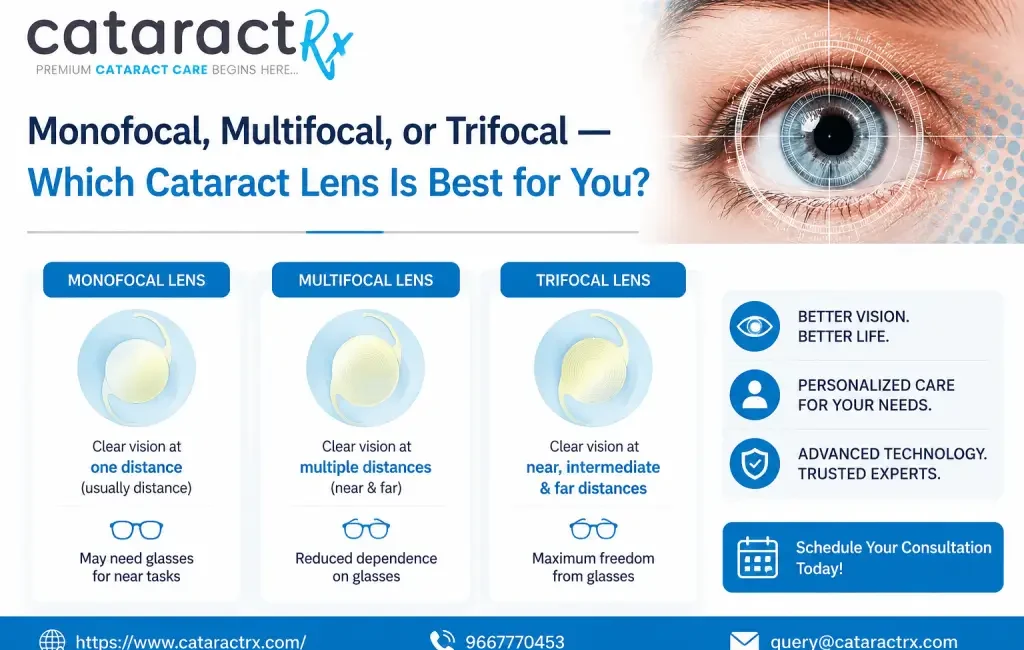
What Are the Best Lenses for Cataract Surgery — Monofocal, Multifocal, or Trifocal?
There is no single best lens for cataract surgery that suits everyone — the right choice depends entirely on your vision needs, daily lifestyle, and how much you want to reduce your dependence on glasses. Here’s how the three core IOL lenses for cataract compare.
1. Monofocal IOL
Monofocal lenses correct vision to only one fixed distance, which is usually far vision. It is the most well-known and most widely used lens for cataracts. It’s a dependable, budget-friendly option included in the majority of insurance plans.
- Best for: patients comfortable wearing reading glasses for near tasks and those who want dependable, standard vision correction without the added cost of premium lens technology.
- Trade-off: you will likely still need glasses for reading, phone use or other close-up work.
2. Multifocal IOL
Multifocal lenses are built with multiple optical zones designed to provide clear vision at near, intermediate, and distance ranges — often eliminating the need for glasses for most daily activities. Among premium cataract surgery options, multifocal lenses are a popular choice for patients seeking strong all-round independence from glasses.
- Best for: people who want maximum spectacle independence and are comfortable accepting a small trade-off in visual quality.
- Trade-off: some patients notice mild glare or halos around lights, particularly at night, especially in the first few months after surgery.
3. Trifocal IOL
Trifocal lenses build on multifocal design by adding a third focal point, giving smoother, more continuous vision across near, intermediate and distance ranges. For many patients weighing cataract surgery options, this translates into noticeably better intermediate vision — useful for computer work, cooking, and dashboard reading — without sacrificing near or far clarity.
- Best for: patients with an active lifestyle who use screens, drive frequently and want the broadest possible range of glasses-free vision.
- Trade-off: like multifocal lenses, some night-time glare or halo effect is possible. However, newer trifocal designs have significantly reduced this compared to earlier generations.
What Other IOL Lenses for Cataract Surgery Should You Know About?
Beyond the three core categories, several specialized IOL lenses for cataract patients address specific visual needs.
Extended Depth of Focus (EDOF) IOL
EDOF lenses offer a smooth, continuous range of focus from distance to intermediate vision, without the distinct optical rings used in traditional multifocal designs. This makes EDOF one of the more natural-feeling cataract lens options, with minimal glare or halos — a strong fit for office professionals, night drivers, and frequent gadget users.
Toric IOL
If you have corneal astigmatism, a toric IOL corrects both the cataract and the astigmatism in a single procedure, improving visual clarity without glasses. Toric technology is now available across monofocal, multifocal and EDOF cataract lens options, so astigmatism doesn’t have to limit your choice of the best lens for cataract surgery.
Premium Multifunctional Lenses
The newest generation of IOL lenses for cataract surgery combines several technologies at once — extended depth of focus, low-light enhancement, and glare or halo reduction — into a single lens. These premium cataract surgery options are designed for active individuals who want consistently clear, glasses-free vision across driving, screen work, and dynamic daily tasks.
What Are the Best Cataract Lens Options in India?
Patients researching cataract lens options India will typically find the full global range of IOL technology available at advanced eye care centers, including monofocal, multifocal, trifocal, EDOF, toric, and premium multifunctional lenses. India’s cataract care ecosystem has kept pace with international standards. Many leading centers now offer femtosecond laser-assisted surgery alongside premium IOL implantation — giving patients access to the same cataract surgery options available in the US and UK, often at a significantly lower cost.
When comparing cataract lens options in India, it’s worth evaluating not just the lens brand or type, but also whether the surgical center uses laser-assisted technology, since precise lens positioning has a direct impact on how well a premium IOL performs after surgery.
How to Choose a Cataract Lens That Matches Your Lifestyle?
Knowing how to choose cataract lens options starts with an honest look at four key factors:
- Your visual goals. Do you primarily want sharp distance vision, comfortable near vision for reading or an all-in-one solution that reduces glasses dependence across every range?
- Your work and lifestyle. Office workers who spend hours on screens have different needs than outdoor professionals or frequent night drivers. Think about what you do most during a typical day.
- Pre-existing eye conditions. Astigmatism, dry eyes, or other conditions may steer you toward — or away from — certain cataract lens options, such as toric IOLs for astigmatism correction.
- Budget and insurance coverage. Monofocal lenses are typically the most affordable and widely covered, while multifocal, trifocal and premium cataract surgery options involve additional cost but offer greater freedom from glasses.
The most reliable way to choose the best lens for cataract surgery is through a personalized consultation with an experienced ophthalmologist who can evaluate your eye health, lifestyle, and expectations before recommending specific IOL lenses for cataract correction.
Is Premium IOL Surgery Worth the Extra Cost?
For many patients, the answer depends on how much they value glasses-free vision. Monofocal lenses remain a perfectly effective, lower-cost option among cataract surgery options for patients who don’t mind wearing reading glasses. However, patients who want to minimize glasses use them for reading and driving. Screen work often finds that premium IOL lenses for cataract surgery — multifocal, trifocal, or EDOF — deliver a noticeably better quality of life, particularly when combined with laser-assisted surgical precision that maximizes how well the lens performs.
Ultimately, the worth of a premium IOL comes down to your personal priorities: convenience and spectacle independence versus upfront cost. A detailed consultation can help you weigh this trade-off and confirm the best lens for cataract surgery based on your specific vision needs.
Talk to a Cataract Specialist About the Right Lens for Your Eyes
Choosing between monofocal, multifocal, trifocal, and EDOF cataract lens options doesn’t have to be confusing. Our experienced ophthalmologists offer detailed, personalized consultations to help you understand every cataract surgery option and select the IOL lens for cataract correction that truly fits your vision goals, lifestyle, and budget — supported by advanced laser-assisted surgical precision for accurate lens placement.
Take the next step toward a clear, confident vision:
- Visit: https://www.cataractrx.com/
- Call: 9667770453
- Email: query@cataractrx.com
Frequently Asked Questions
Q. What is the best lens for cataract surgery?
A. There is no single best lens for cataract surgery that suits everyone. Monofocal lenses are the most affordable and correct one distance, while multifocal, trifocal and EDOF lenses offer varying degrees of near, intermediate, and distance vision with reduced dependence on glasses. The right choice among these cataract surgery options depends on your lifestyle, visual goals, and budget. It should be finalized after a personalized eye evaluation.
Q. What is the difference between monofocal and trifocal lenses?
A. A monofocal lens corrects vision at only one fixed distance, usually far vision, meaning you’ll likely still need reading glasses. A trifocal lens provides three focal points — near, intermediate, and distance — allowing most patients to function with little to no glasses dependence for daily activities.
Q. Are multifocal or trifocal lenses safe for cataract surgery?
A. Yes, multifocal and trifocal IOLs are widely used, well-established lens technologies with a strong safety record among modern cataract surgery options. Some patients may notice mild glare or halos around lights, especially at night, but this typically improves as the eyes adjust after surgery.
Q. How much do premium cataract lenses cost in India?
A. Costs vary depending on the lens brand, technology (multifocal, trifocal, EDOF or toric) and the surgical center. Premium cataract lens options India cost more than standard monofocal IOLs due to their advanced optical design. It’s best to get a personalized quote during a consultation, as pricing depends on your specific eye condition and lens choice.
Q. Can I get cataract surgery with astigmatism?
A. Yes. Toric IOLs are specifically designed to correct astigmatism alongside cataract removal. Toric technology is available in monofocal, multifocal, and EDOF designs, so patients with astigmatism still have access to the full range of cataract lens options.
Q. How do I choose the right cataract lens for my eyes?
A. Knowing how to choose cataract lens options depends on your visual goals, daily lifestyle (screen use, driving, outdoor work), any existing eye conditions like astigmatism or dry eyes, and your budget. An experienced ophthalmologist can guide you through a personalized consultation to recommend the IOL lens for cataract correction best suited to your needs.