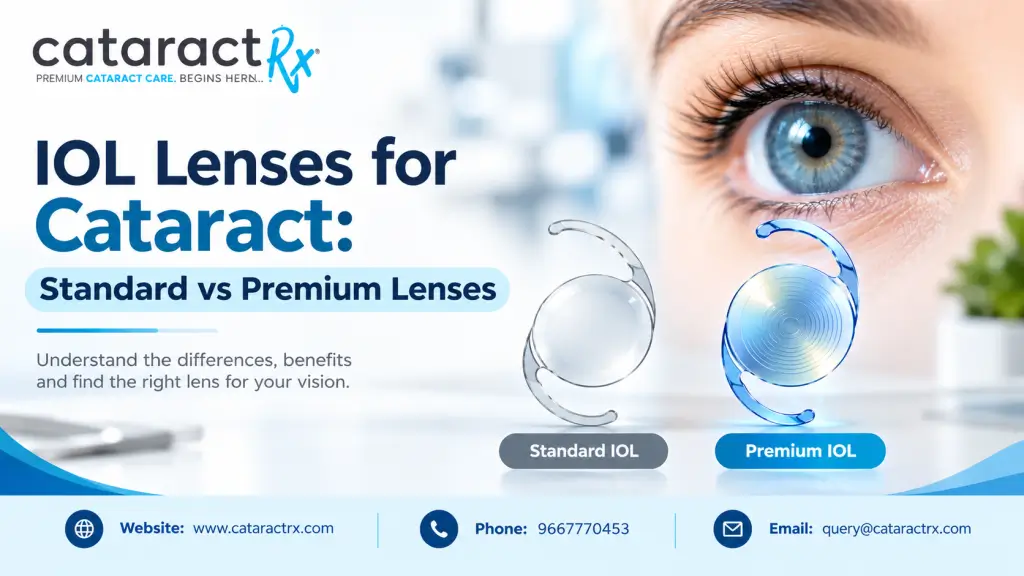
AI Summary:
- IOLs replace the cloudy natural lens during cataract surgery.
- Standard monofocal IOLs usually correct vision at one distance.
- Premium cataract lenses can provide vision across multiple distances.
- Toric lenses can help correct astigmatism.
- Multifocal and EDOF lenses can reduce dependence on glasses for some patients.
- The right lens depends on your eye health, lifestyle, vision goals, and budget.
- An eye specialist should recommend the most suitable lens after an eye examination.
Cataracts make the natural lens of the eye cloudy, which can cause blurry vision, glare, and difficulty seeing clearly. During cataract surgery, the cloudy lens is removed and replaced with an artificial intraocular lens, commonly called an IOL. These lenses help focus light properly inside the eye and restore clearer vision.
Today, patients have several lens choices. Standard lenses are designed to provide clear vision at one main distance. At the same time, premium options can offer a wider range of vision. Understanding these differences can make it easier to discuss your cataract surgery options with an eye specialist.
What Is a Standard IOL?
A standard IOL is usually a monofocal lens. It is designed to provide clear vision at one selected distance.
How Does a Monofocal IOL Work?
Most patients choose distance vision with a monofocal lens. This can help with activities such as:
- Driving
- Watching television
- Walking outdoors
- Recognizing faces from a distance
However, glasses may still be needed for reading, using a smartphone, or doing close computer work.
A standard IOL can be a practical choice for people who are comfortable using glasses when needed.
What Are Premium Cataract Lenses?
Premium cataract lenses are designed to provide vision correction beyond the single-distance focus of a traditional monofocal IOL. Depending on the lens, they may help with near, intermediate, and distance vision.
Common premium options include toric, multifocal, and extended depth of focus (EDOF) lenses.
What Is a Toric IOL?
A toric IOL is designed to correct astigmatism. Astigmatism can cause blurry or distorted vision because of an irregular shape of the cornea or lens.
Toric lenses can provide clear distance vision while addressing astigmatism. However, some patients may still need glasses for reading or other close-up tasks.
What Is a Multifocal IOL?
A multifocal IOL is designed to provide vision at more than one distance. This may include near, intermediate, and far vision.
For suitable patients, multifocal lenses may reduce dependence on glasses after surgery. However, some people may notice visual effects such as halos or glare, especially during the adjustment period.
What Is an EDOF IOL?
An extended depth of focus IOL is designed to provide a broader range of vision. It is particularly useful for intermediate activities such as computer use and smartphone viewing.
EDOF lenses can provide a smooth range from distance to intermediate vision. They may also reduce the need for glasses for many everyday activities, although results differ between patients.
What Is the Difference Between Standard and Premium IOLs?
The main difference is the range of vision they are designed to provide.
A standard monofocal IOL focuses on one distance. Premium lenses can offer correction at multiple distances or address specific vision needs such as astigmatism.
Here is a simple comparison:
- Standard IOL: Usually focuses on one distance.
- Toric IOL: Helps correct astigmatism.
- Multifocal IOL: Provides multiple focal ranges.
- EDOF IOL: Extends the range of clear vision, especially from distance to intermediate.
- Cost: Premium lenses generally involve an additional cost compared with standard options.
The best choice is not necessarily the most expensive lens. It should match your eyes, daily activities and visual expectations.
Which IOL Is Better for Your Lifestyle?
The right IOL depends on what you want your vision to be like after surgery.
When Might a Standard IOL Be Suitable?
A standard monofocal lens may suit someone who:
- Wants clear vision at one main distance
- Does not mind wearing reading glasses
- Has a limited budget for lens upgrades
- Prefers a straightforward lens option
When Might a Premium IOL Be Considered?
Premium options may be considered if you:
- Want to reduce dependence on glasses
- Frequently use computers or smartphones
- Have astigmatism
- Want a wider range of vision
- Have an active lifestyle
An eye specialist can assess your eye health and discuss which lens fits your needs.
Do Premium IOLs Mean You Will Never Need Glasses?
Not necessarily. Premium lenses can reduce dependence on glasses, but they do not guarantee completely glasses-free vision.
Your final visual result can depend on the lens selected, your eye health, healing, and the type of activities you perform. For example, you may still prefer reading glasses for very small print even after receiving a premium lens.
This is why realistic expectations are important when considering advanced cataract treatment.
How Do You Choose the Right IOL Before Cataract Surgery?
Choosing an IOL should be part of your pre-surgery consultation. Your doctor may consider your eye measurements, existing vision problems, lifestyle, and desired visual range.
You should also discuss:
- Your preferred vision distance
- Astigmatism correction
- Night driving needs
- Reading and computer use
- Previous eye conditions or surgeries
- Insurance coverage
- Your overall budget
CataractRx helps patients understand different lens and treatment choices so they can have a more informed discussion with their eye-care provider.
Are Premium IOLs Part of Advanced Cataract Treatment?
Yes. Premium IOLs are one option within modern cataract care. Some patients may also consider laser-assisted procedures such as femtosecond laser-assisted cataract surgery, depending on their clinical needs.
However, the surgical technique and IOL are separate decisions. A premium lens is not automatically necessary for every patient.
The goal is to select a combination that supports safe surgery and the patient’s desired visual outcome.
What Should You Ask Your Eye Doctor About IOLs?
Before surgery, ask questions such as:
- Which IOL is suitable for my eyes?
- What distance will the lens correct?
- Will I still need reading glasses?
- Do I have astigmatism?
- What are the benefits and limitations of premium lenses?
- What additional costs should I expect?
- Which cataract surgery options are appropriate for me?
Clear answers can help you make a decision based on your actual vision needs rather than choosing a lens simply because it is labeled premium.
How Can You Get Help Choosing a Cataract Lens?
Choosing between standard and premium IOLs can feel confusing, especially when several lens types are available. Professional guidance can help you understand your choices and identify an option that fits your vision goals, eye health, and budget.
CataractRx can help patients understand available cataract treatment and IOL choices and connect them with appropriate eye-care services.
- WhatsApp: +91-8800770952
- Phone: +91-9667770453
- Email: query@cataractrx.com
Frequently Asked Questions –
Q. What are IOL lenses for cataract surgery?
A. IOL lenses are artificial lenses placed inside the eye after the cloudy natural lens is removed during cataract surgery. They help focus light and improve vision.
Q. Are premium IOLs better than standard IOLs?
A. Premium IOLs are not automatically better for everyone. They provide additional vision-correction options, but the appropriate choice depends on your eye health, lifestyle, vision goals and budget.
Q. Can premium cataract lenses eliminate glasses?
A. They can reduce dependence on glasses for some patients, but they do not guarantee complete freedom from glasses. Your results depend on the lens type and individual eye factors.
Q. Which IOL is best for computer use?
A. EDOF lenses can be useful for intermediate vision, which is important for activities such as computer and smartphone use. Your eye specialist can determine whether this option suits you.
Q. How do I choose between standard and premium IOLs?
A. Discuss your lifestyle, desired vision range, eye health, astigmatism, expected use of glasses and budget with your eye specialist. These factors can help guide the right choice.