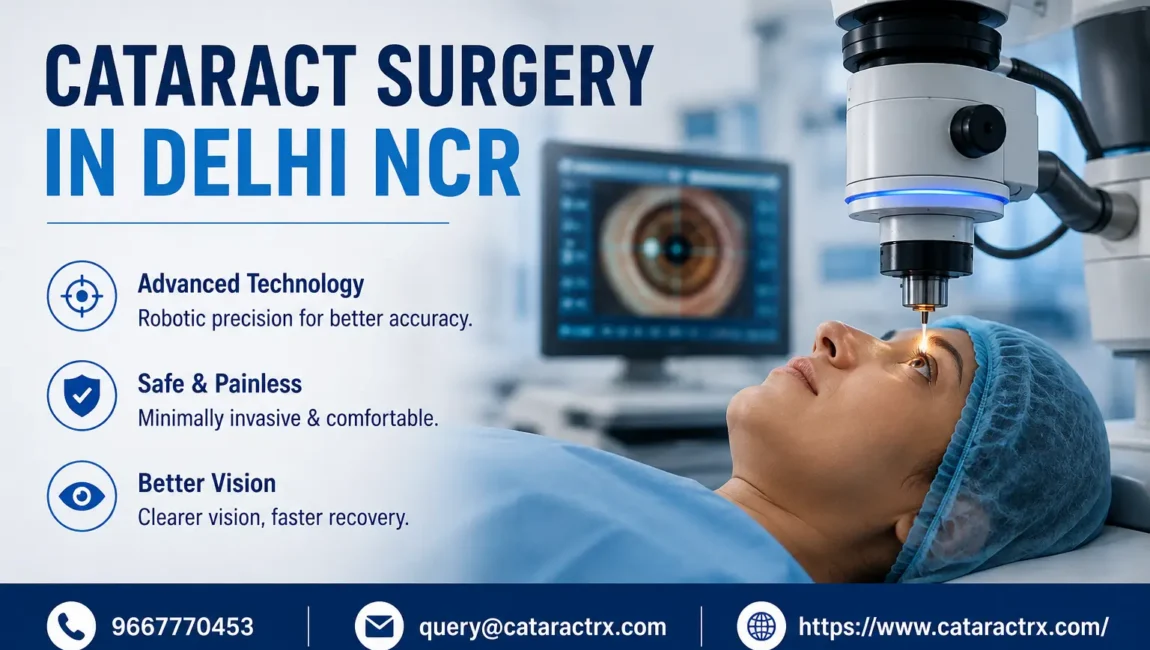
Cataracts remain one of the leading causes of vision loss among adults over 50, and choosing the right surgical approach can make a significant difference in outcomes. For patients exploring cataract surgery in Delhi NCR, safety is often the first and most important consideration. Advances in laser-assisted, robotically guided procedures have changed how surgeons approach precision, recovery and the risk of complications.
This blog breaks down exactly how robotic technology improves safety at every stage of the procedure so that you can make an informed decision about your eye care.
How Does Robotic Technology Improve Precision During Cataract Removal?
Traditional cataract surgery relies on a surgeon’s hand-eye coordination to make incisions and manually break up the clouded lens. Robotic cataract surgery in Delhi uses laser-guided systems to reduce much of this variability by mapping the eye in detail before the procedure begins.
- Incisions are planned and executed with micron-level accuracy.
- The laser creates a predictable, uniform opening in the lens capsule.
- Corneal incisions are more consistent in size, depth, and location.
- Reduced manual manipulation lowers the risk of accidental trauma to surrounding eye tissue.
This level of precision means less unpredictability during the procedure, which directly translates into a lower risk of intraoperative complications.
Why Is Blade-Free Surgery Considered Safer for the Eye?
One of the defining safety advantages of laser-based cataract treatment is the elimination of handheld blades for key surgical steps. Since the laser performs the incisions and lens fragmentation, there is far less physical stress placed on the eye.
- No blade contact reduces the risk of corneal swelling or irregular healing
- Blade-free capsulotomy minimizes the chance of tears in the lens capsule
- Lower mechanical stress on the eye reduces post-operative inflammation
- The procedure is typically stitch-less, which reduces infection risk
For patients with fragile corneas or age-related eye conditions, this gentler approach is often a meaningful safety benefit.
What Makes This Approach Safer for Elderly or High-Risk Patients?
Many cataract patients are seniors and some may have underlying conditions such as diabetes or hypertension that increase surgical risk. Robotic assistance is particularly valuable for this group because it reduces the physical demands of the surgery itself.
- A shorter procedure time means less time spent under topical anesthesia.
- The reduction in tissue trauma can lead to quicker and more secure healing
- Predictable laser settings reduce the chance of surgeon fatigue-related errors
- More favorable outcomes are reported in patients with more severe or advanced cataracts.
Because the technology performs consistently regardless of case complexity, it offers an added layer of reassurance for patients who may otherwise be considered higher risk for conventional surgery.
How Do Premium IOLs Add to the Overall Safety Profile?
Safety isn’t limited to the surgical steps alone; it also depends on how accurately the intraocular lens (IOL) is positioned. Robotic guidance enables precise lens placement, which is especially important when premium lenses are used.
- The precise zenith reduces the possibility of visual disturbances, such as halos or glare
- Accurate positioning supports better long-term visual stability
- Lower likelihood of lens dislocation in comparison to less precise manual positioning
- Enhanced compatibility with current lens designs that require an exact alignment
People considering alternatives like EDOF or multifocal lenses benefit most from this precision, since even small placement errors can affect vision quality later on.
What Happens During a Robotic Cataract Procedure?
Knowing the procedure itself can help ease fears about the procedure. A typical laser cataract procedure in Delhi is a well-planned sequence that is low-risk:
- Detailed eye mapping and measurements are taken before surgery
- Topical anesthetic drops are administered; no injections are needed
- The laser performs the incision and softens the cataract
- The surgeon removes the cataract and places the IOL
- The self-sealing incision typically requires no stitches or bandages
Most procedures are completed within 15–20 minutes per eye and many patients resume light daily activities the next day under medical guidance.
How Should You Evaluate an Eye Hospital Before Booking Surgery?
Safety outcomes also depend heavily on where the procedure is performed. When comparing top eye hospitals for cataract in Delhi, patients should look beyond price and consider clinical credibility.
- NABH accreditation and hygiene standards
- Surgeon experience with laser-assisted and robotic systems
- Access to a range of IOL options, not just one brand
- Transparent pre- and post-operative care protocols
- Availability of emergency support in case of complications
A hospital’s willingness to explain risks clearly, rather than only highlighting benefits, is often a good indicator of trustworthy, patient-first care.
What Determines the Cost of Robotic Cataract Surgery?
Pricing is a common concern, and it’s natural to want clarity before committing to a procedure. Cataract surgery in Delhi cost typically varies based on the technology used, the IOL selected and the hospital’s facilities.
High-end robotic procedures using advanced lenses typically cost more than regular surgery. Many patients find that the reduced need for glasses and lower risk of complications are worth the cost. Mediclaim, insurance, and EMI options are available to reduce your financial strain.
Ready to Book a Safe, Robotic Cataract Consultation?
If you’re weighing your options for a safer, more precise cataract procedure, speak with a qualified specialist before deciding. CataractRx offers guidance on robotic laser cataract surgery, lens selection, and hospital comparisons across Delhi NCR.
- Website – https://www.cataractrx.com/
- Call – 9667770453
- Email – query@cataractrx.com
Frequently Asked Questions –
Q. Is robotic cataract surgery safer than traditional surgery?
A. Yes. Robotic, laser-assisted methods offer greater precision, reduced tissue trauma and lower complication rates compared to fully manual techniques.
Q. Does robotic cataract surgery hurt?
A. No. The procedure uses topical anesthetic drops and is generally painless, with most patients reporting only mild sensitivity afterward.
Q. How long does recovery take after robotic cataract surgery?
A. Most patients notice improved vision within a day or two. They can resume normal activities shortly after, though full healing may take a few weeks.
Q. Are robotic cataract procedures suitable for everyone?
A. Most patients are good candidates, but suitability depends on eye health, cataract density and overall medical history, which your surgeon will assess.
Q. Does insurance cover robotic cataract surgery?
A. Coverage varies by policy and hospital. Many premium procedures may need a co-payment, and care coordinators can help explore EMI or cashless claim options.